
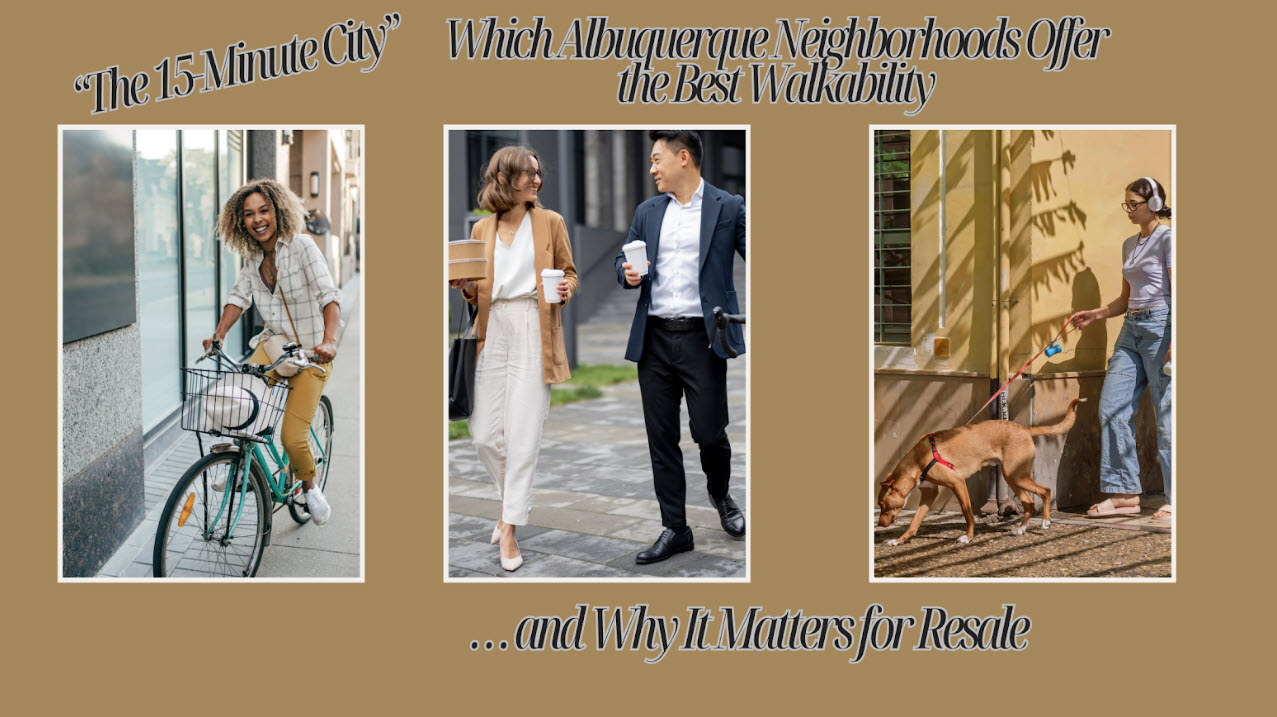
As longtime Albuquerque residents and real estate professionals, we’ve watched our city evolve from a car-dependent sprawl into pockets of genuine walkability that would make urban planners proud. The global movement toward “15-minute cities” – where residents can access most daily necessities within a 15-minute walk, bike ride, or transit trip – has found a surprising footing in the Duke City, creating distinct advantages for property owners in our most walkable neighborhoods.
The data tells a compelling story about the growing value of walkability in our market. While Albuquerque scores just 43 on Walk Score’s walkability index, indicating most errands require a car, several neighborhoods have emerged as true pedestrian havens that command premium prices and demonstrate stronger resale performance.
Have you heard of the 15-minute city movement? Anne Hidalgo, Mayor of Paris, popularized the 15-minute city concept, which many urban planners worldwide have adopted, and represents a return to more traditional neighborhood planning where residents can accomplish all their errands and daily needs with a short walk or a bike ride. On the surface, the 15-minute city appears to be about convenience. Still, upon closer examination, it’s about creating sustainable, healthy communities that reduce car dependency, strengthen local economies, and improve quality of life.
In Albuquerque, this concept takes on unique characteristics shaped by our high desert geography, historic settlement patterns, and transportation infrastructure. Rather than trying to transform the entire metro area, we’re seeing organic 15-minute neighborhoods emerge around key corridors, particularly along Central Avenue and in historically dense areas that predate car-centric development.
The recent success of Albuquerque Rapid Transit (ART) exemplifies this trend. Since its launch, ART has facilitated over 10 million rides and sparked more than $800 million in new construction and renovations within half a mile of the corridor – nearly three times the construction value per square mile compared to the rest of the city.
This investment surge reflects the premium that developers and residents place on transit-accessible, walkable environments.
Nob Hill leads the charge and sets the Gold Standard for the rest of Albuquerque. The Nob Hill neighborhood boasts a Walk Score of 85, making it not just the most walkable neighborhood in Albuquerque, but also one where you can accomplish most errands on foot.
This historic Route 66 corridor has evolved into a genuine mixed-use district where residents can walk to restaurants, shops, entertainment venues, and services while maintaining the authentic character that makes it distinctly Albuquerque.
Nob Hill combines walkability, cultural amenities, and proximity to the University of New Mexico, creating a unique value proposition that attracts everyone from young professionals and academics to empty nesters seeking an active urban lifestyle.
Nob Hill’s market performance numbers speak for themselves. Nob Hill median home prices stand at approximately, $515,000 – representing a stunning 25.4% increase year-over-year – Nob Hill properties command a significant premium over the citywide average of $355,000. This 45% price differential isn’t just about location; it reflects the growing value that buyers place on walkable, transit-connected living.
Nob Hill’s architectural diversity offers everything from 1920s bungalows to contemporary condos, creating options across various price points while maintaining the neighborhood’s distinctive character. The diversity also adds to the neighborhood’s appeal. Properties with original hardwood floors, Spanish Colonial Revival details, and walkable access to Central Avenue’s entertainment district consistently outperform comparable homes in car-dependent areas. Reviewing recent sales data, we found homes in Nob Hill selling in approximately 30 days, slightly faster than the citywide average, with many properties receiving multiple offers.
Old Town is Albuquerque’s historic core and represents Albuquerque’s original 15-minute neighborhood, dating back to the city’s founding in 1706. This landmark plaza district offers a different type of pedestrian appeal – one focused on cultural attractions, traditional New Mexican dining, and over 100 shops and galleries all within a compact, pedestrian-friendly environment.
While Old Town’s residential stock is more limited than Nob Hill’s, properties in and around the historic core benefit from the area’s tourist appeal and cultural significance.
The adjacent Sawmill District was recently built up, with a luxury hotel, food court, and mixed-use developments, and is now extending Old Town’s walkable footprint and creating new residential opportunities that blend historic charm with contemporary amenities.
Public transportation is key to the 15-minute city concept. The fact that Nob Hill connects to the broader ART system means residents can easily access downtown, Nob Hill, and the University area without a car, while still enjoying the unique cultural amenities that make Old Town a destination. Properties here tend to hold their value exceptionally well, with the historic designation providing both character protection and investment security.
University Heights, with its Walk Score of 78, represents the third most walkable neighborhood in Albuquerque and demonstrates how proximity to major institutions creates natural 15-minute environments. The area benefits from UNM’s cultural offerings, sporting events, and the steady population of students, faculty, and staff who prefer walkable lifestyles.
The neighborhood’s tree-lined streets, historic architecture, and easy access to both campus amenities and Central Avenue’s commercial corridor create a unique residential environment. Properties here often feature larger lots and more established landscaping than newer developments, while still providing pedestrian access to daily necessities.
Recent market activity shows University Heights maintaining steady appreciation with strong rental potential, making it attractive to both owner-occupants and investors. A reliable tenant base and consistent property demand come from the combination of academic stability and walkable amenities.
The North Valley, including areas like Los Ranchos, offers a different interpretation of walkable living that emphasizes agricultural heritage and community connections. While not achieving the high Walk Scores of central neighborhoods, the North Valley’s acequia-lined streets, local markets, and community-oriented businesses create a pedestrian-friendly environment that celebrates Albuquerque’s rural traditions within an urban setting.
Properties in walkable sections of the North Valley, particularly around Fourth Street and Mountain Road, offer unique value propositions with larger lots, established trees, and authentic New Mexican character. The Farm & Table restaurant and other locally owned businesses create destinations that draw visitors from across the metro area while serving the daily needs of residents.
The success of Albuquerque Rapid Transit, along with the growing transportation infrastructure, has fundamentally changed the development equation along Central Avenue. We refer to it as the “ART Effect” as we’ve watched the new transportation infrastructure drive Albuquerque development. Did you know that ART was the first Bus Rapid Transit system in the United States to achieve Gold Standard certification from the Institute for Transportation & Development Policy? ART has created a genuine rapid transit service with dedicated lanes, level boarding platforms, and frequent service.
Did you know that Properties within walking distance of ART stations have seen increased interest from buyers who appreciate both the convenience and the environmental benefits of transit-oriented living? The system’s 19 stations connect key destinations from Uptown through downtown, Old Town, and the University area, creating opportunities for car-free living that were previously impossible in Albuquerque.
We continue to watch the development boom along the ART corridor. New construction and extensive renovations building permits are being granted near ART stations, creating a reinforcing cycle where improved transit attracts development, which in turn makes transit more convenient and practical.
The data clearly shows that walkability commands a price premium in Albuquerque’s real estate market. Beyond Nob Hill’s dramatic outperformance, other walkable neighborhoods consistently show stronger appreciation and faster sales than car-dependent areas.
Properties in neighborhoods with Walk Scores above 70 – including Huning Highland Historic District, University Heights, and parts of downtown – typically sell for 15-25% more than comparable suburban homes. This premium reflects buyer confidence in long-term value retention because of the convenience.
The rental market tells a similar story, with walkable neighborhoods commanding higher rents and lower vacancy rates. Young professionals, in particular, show a strong preference for transit-accessible locations, even when they own cars, viewing walkability as a lifestyle amenity worth paying for.
Several trends suggest Albuquerque’s walkable neighborhoods will continue to outperform the broader market. The city’s ABQ RIDE Forward plan includes potential ART extensions to the Westside, which would create new opportunities for transit-oriented development. Climate change concerns are driving more buyers to consider car-light lifestyles. At the same time, remote work flexibility means location amenities matter more than traditional commute patterns.
Zoning reforms allowing accessory dwelling units and mixed-use development in established neighborhoods create opportunities for increased density without sacrificing character. These changes particularly benefit walkable areas where increased housing options support local businesses and strengthen the pedestrian environment.
The generational shift toward urbanist preferences also favors walkable neighborhoods. Millennials and Gen Z buyers consistently prioritize walkability, transit access, and neighborhood amenities over large yards and car-centric suburban amenities.
For property owners and investors, the walkability premium represents more than current convenience costs – it reflects fundamental shifts in housing demand. As such, walkability matters for resale and has investment implications.
Properties in walkable neighborhoods demonstrate several investment advantages, including stronger appreciation rates, faster sales times, and a diverse buyer pool.
Properties with inherent amenities like walkability and transit access tend to hold their value better than those dependent solely on financing availability or employment patterns during economic downturns.
I think we can all agree that the pandemic demonstrated this clearly, as walkable neighborhoods with local amenities performed better than car-dependent areas. Regarding resale, we found that walkable properties in walkable neighborhoods appeal to broader demographic ranges, from young professionals who may not own cars to older residents who prefer not to drive. This demographic diversity creates more stable demand and reduces market volatility.
How can you make the most of Albuquerque’s walkable neighborhoods? Buyers considering Albuquerque’s walkable neighborhoods should understand that they’re not just purchasing a home – they’re investing in a lifestyle and a community development pattern that’s gaining value nationwide. The premium for walkability in our market remains modest compared to coastal cities, so if you’re a buyer who jumps on this trend early, you can take advantage of the walkability opportunities available in Albuquerque.
Sellers in walkable neighborhoods should emphasize transit access, nearby amenities, and the car-optional lifestyle when marketing their homes. We always advise using professional photography to showcase neighborhood streets, nearby businesses, and connections to transit stations. Marketing should target buyers who value urban convenience, sustainability, and active living.
Easy access to transportation, shopping, and entertainment infrastructure while maintaining Albuquerque’s distinctive character represents powerful property investment opportunities. The infrastructure investments in ART and the continued development along Central Avenue create momentum that supports continued appreciation.
After studying the trends, the bottom line is that walkability is a value driver. Albuquerque’s evolution toward 15-minute neighborhoods represents more than an urban planning trend – it reflects fundamental changes in how people want to live in, work in, and participate in their communities. The market already recognizes this shift, with walkable properties commanding significant premiums and demonstrating superior performance metrics.
As longtime residents and real estate professionals, we’ve seen how walkable neighborhoods create vibrant communities that attract and retain residents across demographic groups. The unique mix of neighborhood character, transportation infrastructure, and mixed-use development creates value that extends far beyond simple property appreciation.
If you’re a buyer, seller, or investor considering Albuquerque real estate, then it’s essential to understand the walkability factor. The neighborhoods that embrace 15-minute city principles aren’t just more convenient – they’re becoming more valuable, more resilient, and more desirable with each passing year.
The transformation is still in its early stages, which means opportunities remain for those who recognize the trend and act strategically. In a rapidly changing real estate market, walkable neighborhoods offer both the lifestyle amenities today’s buyers want and the investment security that comes from owning in areas with strong fundamentals and clear development momentum.
Ready to explore Albuquerque’s most walkable neighborhoods? The Sandi Pressley Team knows Albuquerque and understands our neighborhoods and urban development trends.
Are you looking for a walkable home to enhance your daily life or for an investment property in neighborhoods with strong appreciation potential? If you answered yes, then we’re here to guide you through the opportunities Albuquerque offers.
Contact The Sandi Pressley Team:
- Phone: (505)263-2173
- Website: https://www.sandisells.com
Let’s chat about how Albuquerque’s walkable neighborhoods can meet your real estate goals. In a city embracing 15-minute city principles, the right location choice today creates lasting value for tomorrow.
HOT PROPERTY OF THE WEEK
9517 Seabrook Drive NE, Albuquerque, NM 87111

Exquisite Tanoan home situated on oversized corner lot in Abq’s premier gated Golf community. This property exhibits exceptional pride of ownership thru-out. Featuring gorgeous engineered hardwood flooring, wood beamed ceilings; refrigerated air; Navien instant hot & exterior Re-Stucco 5/25! Remodeled custom kitchen boasts quartz counters; high-end SS appliances, commercial grade 6 burner gas stove; pot filler; island & eat at bar. Both formal & informal living/dining spaces, ideal for gatherings. 4 bedrooms w/1 bdrm on main floor, & 3 remodeled bathrooms. Primary Suite w/his & her walk-in closets & remodeled spa like en suite w/soaking tub. Oversized garage has epoxy floors, workbench, & storage. Relax Outdoors on the balcony or under the pergola amid the lush landscaping.
GET YOUR MORNING INSPIRATION WITH THE SANDI PRESSLEY TEAM!
